Bountiful Garden Produce = Sweet Pickle Relish


This small batch recipe makes three pints of relish.
Perfect for the two of us.

     If we didn’t know better we’d swear our cucumber plants were on steroids! We’re not complaining, just trying to find more uses for them including carrying bags of them in our vehicles . . . to pawn off on willing friends.
     I try to pick them when they’re small and I am doing my best to remember that “less is more” when it comes to canning . . . unlike our Kentucky relatives who are again getting ready to can hundreds of jars of pickles (see Dill Pickle recipe).
    This recipe also allowed me to utilize our garden peppers and onions, too.

Sweet Pickle Relish     Makes 3 pints
Seeded cucumbers are ready to be
cut into chunks & pulsed in the
food processor.
4 cups cucumbers, seeded and chopped, skins left on  -- to seed cucumbers cut them in half lengthwise and scoop out the seeds (a spoon works well for this task.) I then cut them into chunks & pulsed them in the food processor until they were chunky.
2 cups yellow or white onions, chopped
1 cup green bell peppers, chopped
1 cup red bell peppers, chopped
¼ cup pickling or Kosher salt
1¾ cups granulated sugar
1 cups cider vinegar
1 tablespoon celery seeds
1 tablespoon mustard seeds

1.     Put all the prepared vegetables in a large bowl. Sprinkle the salt over the chopped vegetables. Cover with cold water and let stand for 2 hours.
Chopped veggies set for 2 hours in cold water.
2.     Drain vegetables well, then press out as much liquid as possible.
Water is drained from the veggies.
3.     In a large pot, combine sugar, vinegar and seeds. Bring to a boil. Add vegetables.
Syrup for veggies is coming to a boil.
4.     Once veggies have been added, bring syrup back to a boil and simmer for 10 minutes.
5.     Add vegetable relish and syrup to sterilized pint jars according to standard canning procedures. (Note: I actually drained the relish, added it to the jars until they were about ¾ to 7/8 full and then filled the jar with the syrup. Any syrup that is left, I refrigerate for a later batch.)
6.     Seal jars (according to standard guidelines) and process in a hot water bath according to your altitude (10 minutes for up to 1000 ft.). Set jars on a cooling rack once jars are taken from the canner.

 For detailed instructions and guidelines for safe home canning, from jar sterilization to choosing the right canning method (water bath vs. pressure cooking) to testing jar seals, go to the USDA Complete Guide to Home Canning and Preserving.

300+ Quart Jars – Dill Pickles


Some of the  pickles that Chris &
Phoennix canned last year!

     300 + quart jars of pickles — it’s true and we even have the pictures to prove it! But, we can’t take credit for this accomplishment! (What would we do with all those pickles?)
     The project was actually an undertaking of our cousins in Kentucky. Chris and Phoennix Norton spearheaded the venture and Chris noted, “The pickles include cucumbers, okra, green beans and hot peppers.” Although the Norton’s have a notable garden Chris admitted, “We got our veggies from local farmers through the farmers market; we do not have the space to grow enough cucumbers for us to use . . . yet.” He added, “When we first started pickling, it was just Phoennix, Mel, Jazz (Chris’s sister and brother-in-law) and I doing it, but the following year a few more friends joined in because they wanted to learn how to can.”
     The recipe came from Chris’ paternal grandmother (Arletta Norton) recipe. She got the recipe from a friend in Mount Vernon, Ky. — Lara McHargue.
     Originally the recipe called for alum, an ingredient that was believed to help create firm, crisp and crunchy pickles. Because of the health warnings now associated with this ingredient, the Norton’s now use grape leaves and Chris tells me that he recently read that oak leaves have a similar effect (aiding in the crunchiness of the pickles). He also noted, “We are hoping to experiment a little on the amount of salt, trying to lower it without compromising the pickles . . . gotta love blood pressure issues!”  
     Chris shared some of his dill pickles at the recent Clara’s Clan reunion in Kentucky and they were a hit! Barry even suggested that he may take up pickle making  . . . but I have not yet seen any evidence that he will make good on that suggestion!

Dill Pickles    Makes approximately 12 quarts
1.  Boil the brine:       
   8 cups distilled white vinegar
   16 cups water
   2 cups pickling salt (other types of salt may cause a cloudy brine)
2.  Sterilize jars in dishwasher or boiling water.
3.  Sterilize lids in pan of hot water until ready to put on jars
4.  Pack jars (after they are sterilized) with
   Cucumbers, peppers, okra, green beans, etc
   2 to 3 cloves garlic (or more if you like)
   1 lg. or 2 smaller sprigs of dill OR 1 head of dill
        1 to 2 grape leaves – this makes them crunchy
5.  Pour hot brine over packed jars; wipe rim of jar with clean hot cloth. Place lid on jar and seal with screw on ring.
6.  Boil jars in water bath for 10 minutes.
7.  Wait 6 to 8 weeks before opening.
Note: If, after 1 to 2 weeks, there is white settlement, open the jar, pour out brine, rinse veggies with cold water and re-do brine and re-process.
Chris offers some of his delicious cucumber pickles to family members
at the recent gathering of "Clara's Clan" in Kentucky.
 For detailed instructions and guidelines for safe home canning, from jar sterilization to choosing the right canning method (water bath vs. pressure cooking) to testing jar seals, go to the USDA Complete Guide to Home Canning and Preserving.

Salsa Pasta Salad . . . for a crowd


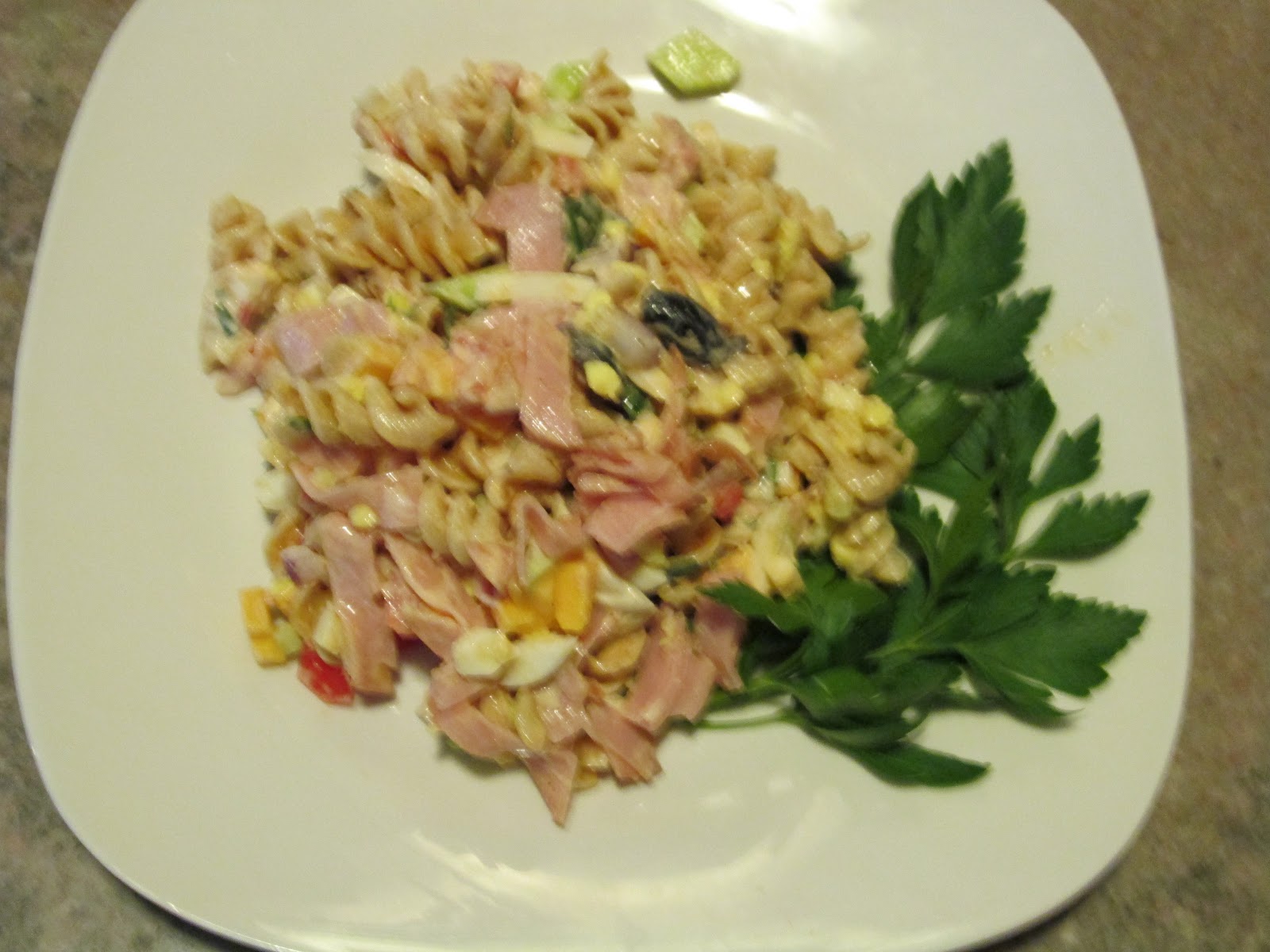
Barry mixes up a large batch of pasta salad
     People used to ask for this recipe when I was catering. I didn’t mind sharing but the truth is that I just added a little of this and that. I started out by adding Ranch dressing and veggies but the salad needed some ZIP . . . so I added salsa; now I usually mix the dressing and salsa prior to pouring it over the pasta.
     Use it as a side salad or add meat (deli or chopped up ham, pork or even bacon) and chopped hard cooked eggs for a main dish salad. Sometimes I just added grated carrots and chopped black olives; other times tomatoes, cucumbers, chopped broccoli, etc. go into the mix.
     Here’s the recipe that I finally wrote down . . . really more of a guide. It is written for 50 but will give you an idea for the portions if you want to cut it down.

Salsa Pasta Salad . . . for 50
Grated carrots make a great
addition to this pasta salad.
3½ lb pasta, uncooked – my favorite is the veggie or whole grain spirals
1½ to 2 quarts Ranch dressing
2 to 4 cups salsa
About 1½ to 2 lb. of veggies of your choice, or use meat & chopped hard cooked eggs  (I almost always add grated carrots – they add color and nutrition and sometimes even trick people into thinking that the salad is full of grated cheese.)
1 to 2+ teaspoons coarse black pepper
Fresh herbs, chopped or dried herbs or seasoning blends to taste

1.     Cook pasta al dent, according to package directions – be sure to salt the water (I add liberal amounts and then don’t have to add more later). Drain and cool slightly.
The pasta cooks in salted water.
2.     Mix up Ranch dressing and salsa — since amounts are variable, I generally mix up the minimum amount and if that’s not enough I just start pouring more dressing and salsa directly on the pasta. (Warm pasta will soak up more dressing.)
Whisking salsa into the Ranch dressing.
3.     Add veggies, meat, etc. + herbs and seasonings.
Note: Ideal to chill the salad for several hours (or overnight) to infuse flavors but if I plan to chill it, I wait to add delicate veggies (like chopped tomatoes) until right before serving. If you make ahead and chill the salad, check before serving as you may need to additional dressing or seasonings.

Adding deli ham, cheese chunks and hard cooked eggs makes this into a main dish salad.

Shaker Recipe --- Tomato Okra Casserole


Thought it fitting to serve Tomato Okra Casserole in
one of Barry's handmade casseroles.
     A long-term fascination with the Shakers has twice lead us to the Pleasant Hill Shaker Village near Harrodsburg, Ky. The first time was about 18 years ago; the most recent was just a couple of weeks ago.
     At one time I did extensive research on this religious sect that lived communally yet practiced celibacy. Their ingenuity is amazing—they invented the circular saw, the flat broom and packaged the first commercial seeds, among other things. Their architectural styles were creative and inventive, their furniture was practical and now is recognized as a classic design form. I admire their division of labor and devotion to equality of the sexes.
     Besides my ongoing interest in the sect, my broom of 18 years was becoming just a little worn. Since we were going to be in Kentucky anyway, I considered it essential to make a stop in Pleasant Hill. We again spent the night (couples sleeping in the same bed must make the Shakers turn over in their graves) and of course we dined on Shaker-style food. And, of course, I bought a cookbook!
     Yes, I needed another cookbook! You see, I needed the recipe for the Tomato Okra Casserole that was on the dinner menu. Barry had fried chicken while I dined on country ham. The sides were served family style and based, in part, on what is currently available in the village’s vast garden.
     The casserole recipe calls for a topping of butter crackers and I questioned whether they would have been available during the peak of the Shaker movement. I did know that the National Biscuit Company (later to become Nabisco) first produced soda crackers in 1898 but a quick search of the Internet indicated that Nabisco didn’t introduce Ritz crackers until 1934. Hmmm – many of the Shaker villages across the U.S. were closed by then; the Pleasant Hill Shaker Village was founded in 1805 and closed in 1910. So I did another search and discovered a similar recipe that simply called for breadcrumbs.      
     Perhaps the version in the cookbook I purchased has been updated for today’s living history museum that strives to share the lives of an earlier generation. Or, perhaps the recipe was actually updated by the surviving Shakers—there are still a few that live on at Sabbath Lake Shaker Village in New Gloucester, Maine. Whatever the explanation, I am glad to have this recipe and still amazed by the Shakers and the village at Pleasant Hill.  

UPDATE in Aug. 2013 — I cut corn off ears of corn and added to okra in step #2. It was a delicious addition!

Tomato Okra Casserole      Serves about 12 
Cookbook Source: Welcome Back to Pleasant Hill, More Recipes from the Trustees' House, Pleasant Hill, Kentucky 
6 tablespoons onions, chopped
2 tablespoons bacon grease
1 lb. okra, sliced
1 quart tomatoes, peeled and cooked, or canned
¼ teaspoon curry powder
½ teaspoon paprika
1 tablespoon granulated sugar
1½ teaspoon salt
¼ teaspoon red pepper
2½ tablespoons Parmesan cheese
8 butter crackers, crumbled

1.  SautĆ© onions in bacon grease.

2.  Add okra and cook until tender. (I used medium or medium-low heat.) Update as of Aug; 2013 -- I added 2 ears of corn, cut from the cob.
3.  Add tomatoes and seasonings.
4.  Pour into greased casserole dish. Top with cheese then cracker crumbs.

5.  Bake at 350° for 35 minutes.
Note -- At the Shaker restaurant, this dish was served alongside rice. It was a great combination and now I usually cook some rice (about 1 cup) and add to the casserole as it bakes.

Read more about the Shaker movement in the US @ http://www.everyculture.com/North-America/Shakers.html or, specific about the Pleasant Hill Shakers can be found  @ http://www.shakervillageky.org/living_history_museum/shaker_history/
Barry stands in a Shaker kitchen with handmade pottery crocks and jugs in the background.
Broom makers continue to make brooms using the equipment at the Shaker Village.
This happens to be a Sisters bedroom; six sisters shared a communal space.
Barry enjoying his Shaker meal -- fried chicken, rice, tomato okra casserole and fresh lima beans.
Working garden at Pleasant Hill Shaker Village.

Adding the Garden to the Gravy — Herbed Sausage Gravy


     There was extra milk and a pound of sausage so it goes without saying that sausage gravy quickly came to mind. But, I wanted to “kick it up a notch” so here’s what I did – chopped a bunch of fresh herbs, pulled an onion from the garden, and heated up the skillet.
     Gravy is really just a flavored (medium) white sauce with a few minor adjustments, so a recipe is not essential if you can remember this simple ratio: 1 cup liquid to 2 tablespoons of flour and fat (the amount of flour and fat is always the same; 1:1). Once you have that memorized, you have the basis for any number of recipes, from gravies to pasta sauces, to soups and much more.
     In my opinion the onions and herbs really did kick the gravy up a notch . . . but then when you start out with fresh ground sausage from Zey’s Market, it’s just a matter of adding even more flavor to an already wonderful product. And, I should note – Zey’s fresh ground sausage is lower in fat than most so adjust the amount of added oil and butter accordingly.

Herbed Sausage Gravy   Serves 4 to 6+
1 lb. ground pork sausage
½ of a large onion, finely chopped
2 to 3 tablespoons fresh chopped herbs – I used thyme, flat-leaf parsley & basil
½ to 1 teaspoon black pepper
4 tablespoons total fat  (after frying the sausage, I estimated I had just about 1 tablespoon of rendered fat so I added 1 tablespoon of butter + 2 tablespoons of olive oil)
4 tablespoons all-purpose flour
2 cups+ milk (I prefer whole milk)
½ to 1 teaspoon dried red pepper flakes, optional
Paprika
Thyme sprigs for garnishing if desired

1.     Crumble the sausage into a large hot skillet (medium-high temperature), stirring to break up any clumps. When about halfway browned, add the onions, fresh herbs and black pepper; cook until nicely browned, stirring occasionally.
Sausage is added to a hot skillet.
After the sausage is partially browned, add the onions and herbs.
2.     Reduce heat to about medium. At this point, estimate the amount of fat in the skillet and add enough butter or olive oil to equal a total of 4 tablespoons fat.
3.     Immediately stir in the flour; continue stirring and let this mixture cook for at least 3 to 5 minutes to avoid a raw flour taste.
Flour has been added to the browned sausage mixture.
4.     Slowly add the 2 cups of milk, stirring as you cook. Cook and thicken, adding additional milk to achieve a gravy-like consistency. As it cooks, add dried pepper flakes and sprinkle with paprika. Taste and adjust seasoning accordingly.
5.     Ladle gravy over biscuits, toast or even mashed potatoes. Garnish with a sprigs of thyme if desired.
I served Herbed Sausage Gravy over biscuits with sliced garden tomatoes and pickled dill okra.

What’s in the Skillet? Cast Iron Skillet Cake


Cast Iron Skillet Cake.
      This is basically a variation of the classic chocolate sheet cake (sometimes called Texas Sheet Cake) but it’s prepared and baked in a cast iron skillet. I suppose you could use any skillet or even a cake pan but the 10” cast iron skillet is the perfect diameter and the cake bakes in about 18 minutes (plus I like the look of the cake baked in the rustic skillet)! 
     We served it at a gathering of college friends, including my sister and brother-in-law, and since I wanted to wait until the last minute to put it in the oven, I combined the cake’s dry ingredients ahead of time – essentially making my own cake mix. Then at the last minute I simple “threw” the ingredients together for a quick and yummy cake.
Cecil Stout (left front), Wayne Hargrove, Barry, and Rich
Gardner (right front) were all fraternity brothers at
KSU. My sister, Marlys Newell Gardner, is also pictured.


Cast Iron Skillet Cake
6 to 8 servings
1 cup all-purpose flour
½ teaspoon baking soda
1 cup granulated sugar
2 tablespoons unsweetened cocoa powder
¼ teaspoon salt
¼ cup (½ stick) butter
½ cup vegetable oil
½ cup water
¼ cup buttermilk
1 egg
½ teaspoon vanilla
Nutty Chocolate Frosting (recipe follows)
For serving: ice cream, chocolate sauce, chocolate mint, if desired

1.  Preheat the oven to 350°.
2.  In a large bowl, whisk flour, baking soda, sugar, cocoa, and salt together and set aside.
Whisk the ingredients until well mixed so they won't lump when poured into the liquid ingredients.
3.  In a 10” cast iron skillet, bring the butter, vegetable oil, and water to a boil.
The skillet is used to melt the liquids and to bake the cake. One less dish to wash!
4.  Remove skillet from the heat and whisk in the dry ingredients well.
Mixing the dry ingredients into the oil mixture.
5.  Mix the buttermilk, egg, and vanilla in a small container. Temper this mixture by adding a little of the hot ingredients to the egg mixture and whisk. Once tempered, add the egg mixture to the skillet and mix thoroughly.
Add a little of the hot liquid is stirred into to the egg mixture to temper.
6.  Bake the skillet cake at 350 for about 15 to 20 minutes or until a toothpick comes out with just a few moist crumbs. 
7.  As the cake cools , make the frosting and spread over the warm cake.
8.  Serve with ice cream, chocolate sauce, and a sprig of chocolate mint if desired.
I used a mesh strainer to
"sift" the powdered sugar.

Frosting
¼ cup (½ stick) butter
2 tablespoons cocoa
3 to 4 tablespoons milk, milas needed for consistency
2 cups powdered sugar, sifted
½ cup pecans, chopped
½ teaspoon vanilla


1.  In a medium saucepan, bring the butter, cocoa, and milk to a boil.
Giving the mixture a quick stir!
2.  Remove saucepan from heat and add sifted powdered sugar sugar, nuts, and vanilla.Stir to combine.
Stirring in the powdered sugar.
3.  Pour over the warm cake, spread with a spatula.

I cut the cake into wedges and served it with vanilla ice cream and chocolate sauce;
it is garnished with a sprig of chocolate mint. 

Recipe w/out photos . . .

Cast Iron Skillet Cake   6 to 8 servings
1 cup all-purpose flour
½ teaspoon baking soda
1 cup granulated sugar
2 tablespoons unsweetened cocoa powder
¼ teaspoon salt
¼ cup (½ stick) butter
½ cup vegetable oil
½ cup water
¼ cup buttermilk
1 egg
½teaspoon vanilla
Nutty Chocolate Frosting (recipe follows)
For serving: ice cream, chocolate sauce, chocolate mint, if desired

1.  Preheat the oven to 350°.
2.  In a large bowl, whisk flour, baking soda, sugar, cocoa, and salt together and set aside.
3.  In a 10” cast iron skillet, bring the butter, vegetable oil, and water to a boil.
4.  Remove skillet from the heat and whisk in the dry ingredients well.
5.  Mix the buttermilk, egg, and vanilla in a small container. Temper this mixture by adding a little of the hot ingredients to the egg mixture and whisk. Once tempered, add the egg mixture to the skillet and mix thoroughly.
6.  Bake the skillet cake at 350 for about 15 to 20 minutes or until a toothpick comes out with just a few moist crumbs. 
7.  As the cake cools , make the frosting and spread over the warm cake.
8.  Serve with ice cream, chocolate sauce, and a sprig of chocolate mint if desired.

Frosting
¼ cup (½ stick) butter
2 tablespoons cocoa
3 to 4 tablespoons milk, as needed for consistency
2 cups powdered sugar, sifted
½ cup pecans, chopped
½ teaspoon vanilla

1.  In a medium saucepan, bring the butter, cocoa, and milk to a boil.
2.  Remove saucepan from heat and add sifted powdered sugar sugar, nuts, and vanilla.Stir to combine.
3.  Pour over the warm cake, spread with a spatula.

Beefing Up MyPlate — Sumptuous Steak Stir-Fry

     Lean, healthy and packed with protein, this beef stir-fry was one of the recipes suggested when Barry completed the Kansas Beef Council’s online personality assessment that coordinates with the USDA's new dietary guidelines. 
     Since he’s been quite health conscious as of late, it seems only fitting that his assessment declared him a “Lean Lover” and explained that a 3-oz. portion of lean beef has only 150 calories, on average; it’s packed with protein which provides a feeling of satisfaction that helps with weight management. 
     We gave this recipe a thumbs up and plan to add it to our plate again and again.
     Check out the Kansas Beef Council's page — it's  is full of lots of other recipes, nutritional tips.
     To take the eating personality assessment, click on My Plate, My Way. (And, to see the results of mine, check out the recipe for Beef Breakfast Pizza OlĆ©. )

Sumptuous Steak Stir-Fry   Makes 4 servings
Total recipe time: 20 to 30 minutes
Above: Remove the strings from snow
 peas.
Below: Cut veggies --I used a diagonal
cut on carrots & celery.
1 pound beef top round steak, cut 1-inch thick
1 small yellow bell pepper, cut into thin strips
1 cup broccoli florets
2 medium carrots, sliced
1/2 cup fresh snow peas, trimmed
1 stalk celery, sliced
1/2 cup frozen shelled edamame*, defrosted
2 cloves garlic, minced, divided
1/4 cup water
Salt
1/3 cup sesame-ginger stir-fry sauce
1/4 to 1/2 teaspoon crushed red pepper
3 cups hot cooked brown or white rice, prepared without butter or salt

1.     Combine vegetables, half of garlic and water in large nonstick skillet; cover and cook over medium heat 3 to 5 minutes or until crisp-tender, adding additional water if pan becomes dry. Remove vegetables; keep warm.
2.     Meanwhile, cut beef steak lengthwise in half, then crosswise into 1/8 to 1/4-inch thick strips. Combine with remaining half of garlic.
Barry cuts the beef into thin strips. The thin cut breaks down connective tissue resulting in a tender beef. 
3.     Heat same skillet over medium-high heat until hot. Add half of beef mixture; stir-fry 1 to 2 minutes or until outside surface of beef is no longer pink. (Do not overcook.) Remove from skillet; season with salt, as desired. Keep warm. Repeat with remaining beef mixture.
Beef sears quickly and is losing it's pink color. 
4.     Return all beef and vegetables to skillet. Add stir-fry sauce and crushed red pepper, as desired; cook and stir 1 to 2 minutes or until heated through. Serve over rice.
.
Couldn't resist --I just had to add an Asian influence to our delicious stir-fry that we served over brown rice.
Note: Edamame is young green soybeans that add additional protein to this dish plus an interesting taste and texture. Although you could vary the veggies in this dish (adding your favorites or using what you have on hand) we really liked the addition of this particular veggie.