PAT Pasta Party -- BEST TOMATO SAUCE

One of the comments from the USD 435's Parents as Teachers Pasta Party on 4/20/15 was "Homemade sauce is way better than canned." I agree! The  recipe from the cookbook Good and Cheap, by Leanne Brown, is simple and quite adaptable to personal tastes. For the party, we increased the quantity to serve 50 + made a few adjustments and changes which I've outlined below.
Also, we cooked mostly WHOLE GRAIN SPAGHETTI, mixed with some regular spaghetti (about 2/3 whole grain to 1/3 regular) . . . if you are trying to transition your family from regular to whole wheat, this is a great way to do it.
The sauce is meat free but we figured that there were quite a few meat lovers in our group, so Barry came early and cooked the meat additions — for 50, he sautéed 2 finely chopped onions and 2 diced green peppers; then he added 4 lbs. of ground chuck and 1 lb. of ground pork and cooked it until it was nicely browned. Then he added a couple of bay leaves, salt and pepper, quite a bit of Italian seasoning and 2 diced zucchini (this is a great way to add more vegetables to your diet and most didn't even realize they were in the sauce!).  He simmered this for about 30 minutes and then we eventually added the BEST TOMATO SAUCE to the meat mixture. As families went though the buffet, they could select either meat sauce or plain tomato sauce.
The rest of the menu included: Garden salad (a blend of spinach, baby kale, Chinese cabbage, head lettuce, romaine, finely sliced red cabbage, shredded carrots and quartered grape tomatoes) + warm garlic bread.
A BIG thanks to volunteers: Barry, Kohl's associates, National Honor Society students, Kelly and Denise. It was a FUN evening and your help was invaluable!
By the way, this event was made possible by our grant from the Community Foundation of  Dickinson County. It is the second of five cooking sessions based on the cookbook Good and Cheap, by Leanne Brown.
We made Cornmeal Crusted Veggies from Ms. Brown's cookbook during the first cooking session. 
Barry and Brandon (a National Honor Student from AHS) cooking up a batch of sauce.
Volunteers Denise, Kelleye + Sarah cooking up batches of sauce. 
Barry and a Kohl's volunteer washing up the dishes.
BEST TOMATO SAUCE with a few of our additions
1 tablespoon olive oil
About 1/4 cup onions (our addition)
3 clove garlic, finely chopped
16 oz. can tomatoes, crushed or diced (I actually purchased cans of both + some tomato sauce and mixed them all together when preparing the large quantity of sauce)
1/2 teaspoon chili flakes 
About 2 to 3 teaspoons Italian seasoning (our addition)
About 1 tablespoon granulated sugar (our addition; it cuts the acid in the tomatoes)
Salt and pepper to taste
  1. Add the olive oil to a saucepan on medium heat. 
  2. Add the onions and sauté until almost tender and translucent; add the garlic about the last 1 minute.
  3. Add the tomatoes, mix and cook until warmed through.
  4. Add the chili flakes, Italian seasoning, sugar and salt and pepper to taste. 
  5. Simmer sauce for about 20 to 30 minutes, stirring occasionally. 
  6. Check taste and adjust seasoning as needed.
    PAT families going through the buffet.
    PAT families enjoying their pasta meal. 

HOOT OWL CHEESE BALL for Chi Omega Reunion


This week the Kappa Alpha chapter of Chi Omega sorority celebrates 100 years on the Kansas State University campus. Just to clarify – I was an initiate in the late 60s; I do not date back to the 1915 pledge class!
            In anticipation, Shelly Bergerhouse Merriam has reunited what she terms the “Sassy Sisters of the Sixties” — we’ve been exchanging pics and bios and it’s been a HOOT!
            The owl is one of the symbols of Chi Omega so for the Friday night 60s gathering in Manhattan, I made a HOOT OWL CHEESE BALL.

HOOT OWL CHEESE BALL
About ¼ to ½ of a yellow or white onion
8 oz. block of cheese (I used a combination of sharp Cheddar & Colby-Jack cheese)
1 (8 oz.) pkg. cream cheese, softened
1 tablespoons Worcestershire sauce
3 to 4 drops hot sauce
Carrot
1 cashew, toasted
2 cloves
2 pointed tortilla chips or corn chips
Sliced almonds, toasted (Bake at 350° for 4 to 5 minutes until just golden brown)
  1. Place onion in food processor fitted with the chopping (metal) blade. Pulse until onion is finely minced.
  2. Remove metal blade from food processor and insert grating disk. Cut block of cheese into sizes that can be inserted into the feed tube of the food processor; grate.
  3. Remove grating disk and reinsert metal blade. Add cream cheese that has been divided into chunks, Worcestershire sauce and hot sauce. Pulse until mixture is well blended.

  4. Remove mixture from food processor and place in a mixing bowl. Chill until it it partially firm.
  5. Form the cheese ball into an "owl" shape (a rounded triangle), smoothing the surface as you shape. 
  6. Cut lengthwise slices from the end of the carrot and cut out V-shapes to create the owl feet; insert under owl body.
  7. Cut off the pointed end of carrot and slice out a V-shape to create a beak. Insert.
  8. Insert a cashew nose above the beak.
  9. Cut to thin carrot circles for eyes. Using a knife, bore a tiny hole all the way through the center of both carrot circle; insert a clove into each and then press eyes into the owl body.
  10. Add triangle shaped tortilla chips for ears.
  11. Insert sliced almond on the lower front, sides and back of the owl.
The owl was a hit and the party was a HOOT! 
Melodie OTT Friedbach & Shelly
BERGERHOUSE Merriam.
Oh look, Melodie made an
owl cheese ball, just like mine! 
Cheers! 
Marcia DIEKMAN Corey & Libby Dyke Randall.
Here I am talking to my
pledge mom, Marcia
DIEKMAN Corey.
Barry with Marcia.
Here's another owl recipe— Kay Emil-Powell's  Chi Omega Hoot Owl Cookies .

Recipe without photos . . .
HOOT OWL CHEESE BALL
About ¼ to ½ of a yellow or white onion
8 oz. block of cheese (I used a combination of sharp Cheddar & Colby-Jack cheese)
1 (8 oz.) pkg. cream cheese, softened
1 tablespoons Worcestershire sauce
3 to 4 drops hot sauce
Carrot
1 cashew, toasted
2 cloves
2 pointed tortilla chips or corn chips
Sliced almonds, toasted (Bake at 350° for 4 to 5 minutes until just golden brown)
  1. Place onion in food processor fitted with the chopping (metal) blade. Pulse until onion is finely minced.
  2. Remove metal blade from food processor and insert grating disk. Cut block of cheese into sizes that can be inserted into the feed tube of the food processor; grate.
  3. Remove grating disk and reinsert metal blade. Add cream cheese that has been divided into chunks, Worcestershire sauce and hot sauce. Pulse until mixture is well blended.
  4. Remove mixture from food processor and place in a mixing bowl. Chill until it it partially firm.
  5. Form the cheese ball into an "owl" shape (a rounded triangle), smoothing the surface as you shape. 
  6. Cut lengthwise slices from the end of the carrot and cut out V-shapes to create the owl feet; insert under owl body.
  7. Cut off the pointed end of carrot and slice out a V-shape to create a beak. Insert.
  8. Insert a cashew nose above the beak.
  9. Cut to thin carrot circles for eyes. Using a knife, bore a tiny hole all the way through the center of both carrot circle; insert a clove into each and then press eyes into the owl body.
  10. Add triangle shaped tortilla chips for ears.
  11. Insert sliced almond on the lower front, sides and back of the owl.

Steve's Gumbo Griddle Cakes

Steve's Gumbo Griddle Cakes were featured in the spring 2015 edition of Sunflower Living magazine, my Chef's Table article for the quarterly publication. (Grilled Gumbo Goodness, Sunflower Living Magazine, spring, 2015, pp. 14-17)
I found out about this recipe at a birthday celebration (his wife Cindy and I both share the same birth date and we were celebrating with Judy Burgess whose birthday is just a few days ahead of ours). As we were dining, Steve told me about his okra pancakes.  His enthusiasm for this recipe, and the stories behind it,  intrigued me, especially since we had a garden full of okra. A few days later, I called him and he shared the recipe and even sent photos of what the batter should look like. I tried them; we loved them, and, I continued to make them all summer long.
Here's the recipe with a few additional details + some of the photos I took of Steve during the magazine photo shoot, some of which did not appear in the article due to space restraints.


Read Steve's story @ Grilled Gumbo Goodness Sunflower Living Magazine, spring, 2015, pp. 14-17.

GUMBO GRIDDLE CAKES     SERVES 6-8
PREPARATION TIME — About 25 minutes

ABOUT THE RECIPE
Steve describes his savory recipe as a meal-in-one. Since his second griddle cake generally turns out better than the first, he suggests doing a test run on the first one. “It’s a chance to check the consistency of the batter and to make sure the heat is correctly adjusted,” he notes.

3 cups okra
2 medium tomatoes, diced and drained of excess juice
½ of a yellow onion
1 small green pepper
1 cup ham, cubed
1 cup baking mix, such as Bisquick®
2 large eggs
¼ cup water
Salt and pepper to taste
Olive oil, allow about 1 teaspoon to a tablespoon of oil for each skilletfull of pancakes
  1. Prepare okra, tomatoes, onions and pepper by cutting into a medium dice, measuring about ½ inch.
  2. In a bowl, mix all ingredients except olive oil—mixture will be mainly veggies with just enough batter to hold the veggies and ham together.
    Steve mixes up the ingredients during the photo shoot in our kitchen.

  3. Heat about a teaspoon to tablespoon of oil in a skillet set on medium heat (amount of oil is dependent on the type and size of skillet).
  4. Using a ½ cup measure, ladle mixture into hot oil. Use the first cake as a test—if the pancake does not hold together, add a little more water; if it seems thin, add additional baking mix.
  5. Once the batter is in the skillet, reduce heat to medium to avoid overcooking the vegetables, and use a spatula to flatten the cake so the vegetables are just one layer thick. Depending on the size of the skillet, 2 or 3 cakes may be cooked at one time.
  6. Cook cakes until small bubbles form on top and side surfaces; undersides should be golden brown and should set in about 3 to 4 minutes. If cakes begin to fall apart when flipped, they need additional cooking time.
  7. Once cakes are flipped, again let the bottoms brown—batter should be cooked through and the veggies should be tender crisp.
  8. Repeat until all of batter is used, replenishing oil as needed. Or, batter may be covered and stored in the refrigerator for several days.
 Additional preparation details: 
  • CHOPPED VEGGIES — Because he likes to taste the individual components of each ingredient in every bite, Steve cuts all the ingredients using a medium dice, measuring about ½ inch.
  •  PROPORTION — Steve’s formula for the perfect proportion of veggies for his Okra-Ham Griddle Cakes: Quantity of tomatoes + onions + green pepper = the amount of cut okra.
  • BATTER UP  — The griddle cake mixture is made up of a high percentage of raw vegetables and ham to batter, it’s hard to imagine the proportions. Seeing is believing, and in this case, a photo really is worth a thousand words.
  • CRAZY ABOUT CAST IRON — Steve fries his griddle cakes in a cast iron skillet. An ideal heat conductor, cast iron heats evenly and consistently. When well seasoned, a cast iron skillet is stick resistant, requiring little or no additional oil.
  • READY TO FLIP — When small bubbles form on the surface and sides of the 
Griddle Cake Versatility
  • Breakfast or brunch: Top griddle cakes with an egg.
  • Vegetarian: Leave out ham for a meat-free offering.
  • Appetizer-sized griddle cakes: Use ¼ to ⅓ cup of batter; top each finished cake with a  dollop of sour cream, and offer as a first course starter, as finger food for game night, or for a cocktail party.
  • Add a topping: Use dollops of sour cream or salsa, or serve with a cream sauce.
  • Vary or change up ingredients: Try adding corn, mushrooms, chives, or garlic..
Recipe without photos . . .
GUMBO GRIDDLE CAKES     SERVES 6-8
PREPARATION TIME — About 25 minutes

ABOUT THE RECIPE
Steve describes his savory recipe as a meal-in-one. Since his second griddle cake generally turns out better than the first, he suggests doing a test run on the first one. “It’s a chance to check the consistency of the batter and to make sure the heat is correctly adjusted,” he notes.

3 cups okra 
2 medium tomatoes, diced and drained of excess juice
½ of a yellow onion
1 small green pepper 
1 cup ham, cubed
1 cup baking mix, such as Bisquick®
2 large eggs
¼ cup water 
Salt and pepper to taste
Olive oil, allow about 1 teaspoon to a tablespoon of oil for each skilletfull of pancakes 
  1. Prepare okra, tomatoes, onions and pepper by cutting into a medium dice, measuring about ½ inch.
  2. In a bowl, mix all ingredients except olive oil—mixture will be mainly veggies with just enough batter to hold the veggies and ham together.
  3. Heat about a teaspoon to tablespoon of oil in a skillet set on medium heat (amount of oil is dependent on the type and size of skillet).
  4. Using a ½ cup measure, ladle mixture into hot oil. Use the first cake as a test—if the pancake does not hold together, add a little more water; if it seems thin, add additional baking mix.
  5. Once the batter is in the skillet, reduce heat to medium to avoid overcooking the vegetables, and use a spatula to flatten the cake so the vegetables are just one layer thick. Depending on the size of the skillet, 2 or 3 cakes may be cooked at one time.
  6. Cook cakes until small bubbles form on top and side surfaces; undersides should be golden brown and should set in about 3 to 4 minutes. If cakes begin to fall apart when flipped, they need additional cooking time.
  7. Once cakes are flipped, again let the bottoms brown—batter should be cooked through and the veggies should be tender crisp.
  8. Repeat until all of batter is used, replenishing oil as needed. Or, batter may be covered and stored in the refrigerator for several days.

Rice and pasta team up in RICE & PASTA PILAF – our starchy side for Easter dinner

Rice & Pasta Pilaf was the starchy side dish for our Easter dinner menu:
---
Roasted Cornish Hens
Rice & Pasta Pilaf
---
Cream Puffs filled with Creamy, Dreamy Lemon Pudding
Easter dinner 2015 
This pilaf features basmati rice as well as pasta. So, what is pilaf?
Pilaf is a dish in which rice is cooked in broth. It generally contains onions, a mix of spices and sometimes vegetables and dried fruits. This one also include pasta which is browned in oil for added color and a nutty flavor.
And what about basmati rice? It is a unique species of rice originating in India. It has its own unique smell and taste— distinctive, unique and slightly nutty; it’s texture is light and fluffy. Just like all species of rice, basmati is available in white or brown versions, depending on the extent of the milling process.

Rice & Pasta Pilaf   8 servings 
1 cup basmati long-grain rice 
3 cup chicken broth
1 tablespoon butter
2 tablespoons olive oil
½ cup orzo pasta 
1 ½ to 2 tablespoons chopped fresh chives
½ of an onion, chopped 
1 large clove garlic, finely chopped
Additional chopped chives for garnish if desired
  1. Place rice in a bowl, cover with chicken broth and let set for 20 minutes for maximum grain length.
  2. Heat butter and olive oil in a medium pot over medium heat. Add the orzo, chives, and onion, cook until the orzo starts to brown; add garlic and continue to cook until orzo turns golden brown and the onions are softened, 3 to 4 minutes.
  3. Stir in the rice and chicken stock. Bring to a boil, then reduce the heat and simmer, covered, for 18 minutes.
  4. Fluff with a fork and serve. Garnish with additional chopped chives if desired.

    Recipe without photos . . .
    Rice & Pasta Pilaf   8 servings 
    1 cup basmati long-grain rice 
    3 cup chicken broth
    1 tablespoon butter
    2 tablespoons olive oil
    ½ cup orzo pasta 
    1 ½ to 2 tablespoons chopped fresh chives
    ½ of an onion, chopped 
    1 large clove garlic, finely chopped
    Additional chopped chives for garnish if desired
    1. Place rice in a bowl, cover with chicken broth and let set for 20 minutes for maximum grain length.
    2. Heat butter and olive oil in a medium pot over medium heat. Add the orzo, chives, and onion, cook until the orzo starts to brown; add garlic and continue to cook until orzo turns golden brown and the onions are softened, 3 to 4 minutes.
    3. Stir in the rice and chicken stock. Bring to a boil, then reduce the heat and simmer, covered, for 18 minutes.
    4. Fluff with a fork and serve. Garnish with additional chopped chives if desired.

Carrot Soup for Easter – every bunny is going to love this!

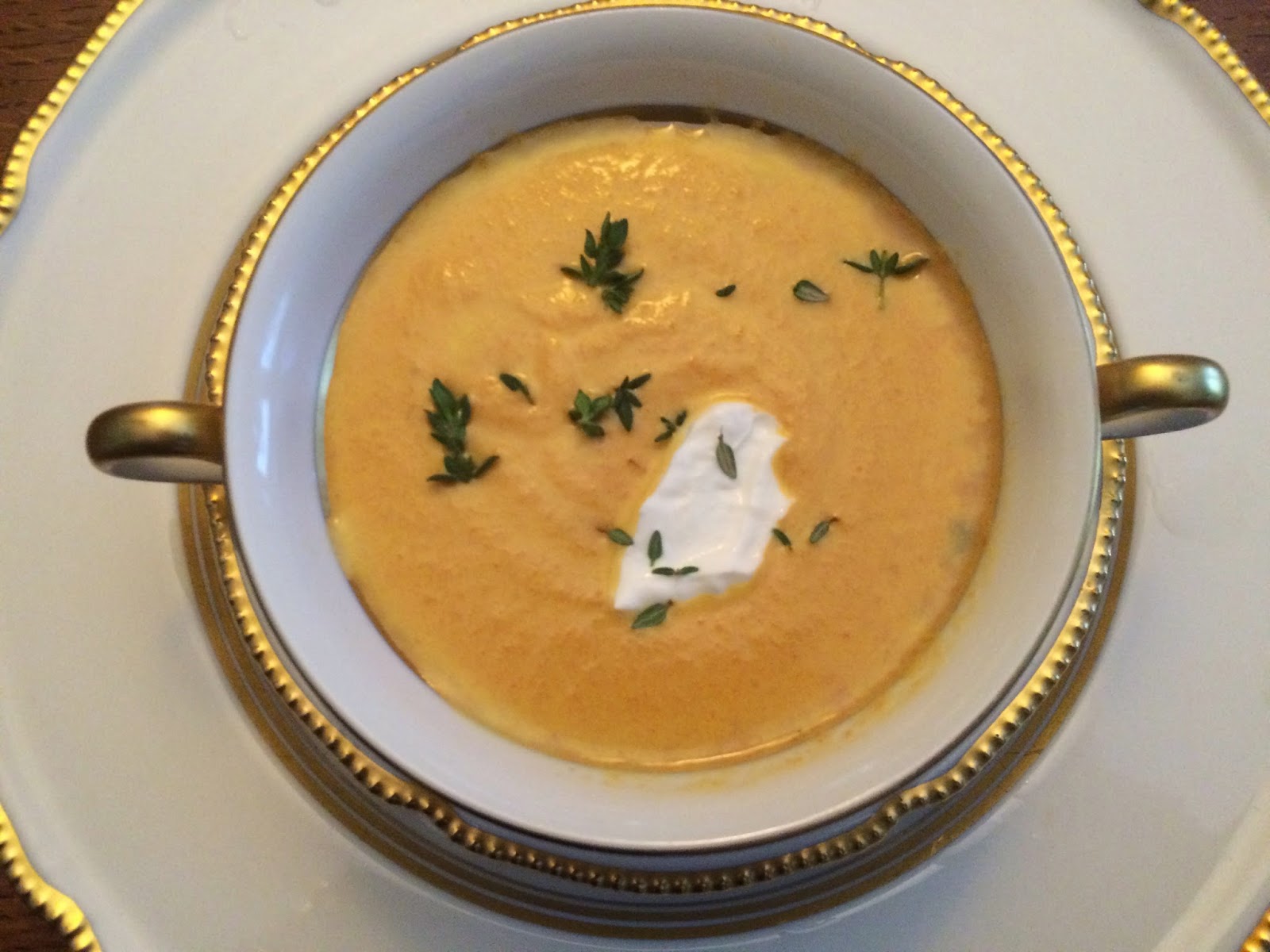
Cream of Carrot Soup in my Grandma
Richardson's china soup bowls.
I needed a soup for Easter to put in the elegant soup bowls that are part of my Grandmother Richardson’s set of china. These bowls don’t hold much; they are definitely first course soup bowls.
Because it’s Easter, I naturally thought of carrot soup. Although I like carrots – both raw and cooked, I still have nightmares about the carrot juice that my mother MADE me drink daily . . . she thought it would improve my eyesight. It didn’t! 
Be assured—this soup is creamy and packed with flavor, and nothing like that nasty carrot juice from yonder years!

Creamy Carrot Soup  Makes 4 3/4 cups
1 tablespoon butter
1 tablespoon olive oil
1 onion, chopped
3 to 4 cups chicken broth
1 lb. carrots, peeled and sliced
½ teaspoon of Kosher salt
½ teaspoon white pepper
2 to 3 teaspoons fresh thyme leaves
Pinch of curry powder
1 tablespoon packed brown sugar
3/4 cup heavy cream
Sour cream
Thyme leaves for garnish
  1. In a large pan, over medium high heat, heat butter and olive oil; add onions and cook, stirring often, until onions are limp.
  2. Add 3 cups broth, carrots, salt and pepper, thyme leaves, curry and brown sugar.
  3. Cover and bring to a boil. Reduce heat and simmer until carrots are tender when pierced.
  4. Remove from heat, cool and transfer to a blender*, or use a handheld blender and blend soup in the cooking pot. Note: At this point I cooled and refrigerated soup and then proceeded with the next step on the following day.
  5. Reheat the blended soup, and add cream. Add additional 1 cup of broth depending on the consistency you prefer for the soup. (I did not add any additional broth.)
  6. Heat over medium-high until soup is hot. Taste and adjust seasonings.
  7. Ladle into bowls and garnish with dollop sour cream** and thyme leaves.
*If using a countertop blender: Remove liquid from the heat and allow to cool for at least 5 minutes. Transfer liquid to a blender or food processor and fill it no more than halfway. If using a blender, release one corner of the lid. This prevents the vacuum effect that creates heat explosions. Place a towel over the top of the machine, pulse a few times then process on high speed until smooth.


Recipe without photos . . .
Creamy Carrot Soup  Makes 4 3/4 cups
1 tablespoon butter
1 tablespoon olive oil
1 onion, chopped
3 to 4 cups chicken broth
1 lb. carrots, peeled and sliced
½ teaspoon of Kosher salt
½ teaspoon white pepper
2 to 3 teaspoons fresh thyme leaves
Pinch of curry powder
1 tablespoon packed brown sugar
3/4 cup heavy cream
Sour cream
Thyme leaves for garnish
  1. In a large pan, over medium high heat, heat butter and olive oil; add onions and cook, stirring often, until onions are limp.
  2. Add 3 cups broth, carrots, salt and pepper, thyme leaves, curry and brown sugar.
  3. Cover and bring to a boil. Reduce heat and simmer until carrots are tender when pierced.
  4. Remove from heat, cool and transfer to a blender*, or use a handheld blender and blend soup in the cooking pot. Note: At this point I cooled and refrigerated soup and then proceeded with the next step on the following day.
  5. Reheat the blended soup, and add cream. Add additional 1 cup of broth depending on the consistency you prefer for the soup. (I did not add any additional broth.)
  6. Heat over medium-high until soup is hot. Taste and adjust seasonings.
  7. Ladle into bowls and garnish with dollop sour cream** and thyme leaves.
*If using a countertop blender: Remove liquid from the heat and allow to cool for at least 5 minutes. Transfer liquid to a blender or food processor and fill it no more than halfway. If using a blender, release one corner of the lid. This prevents the vacuum effect that creates heat explosions. Place a towel over the top of the machine, pulse a few times then process on high speed until smooth.