Make Ahead Sausage-and-Grits Casserole

This is my version of a recipe for a breakfast casserole in the December 2015 holiday issue of Southern Living. Not only did the photo of the dish look yummy, this note on the recipe mentioned that it could be made ahead . . . “You can assemble this up to four days ahead, and keep in the fridge; then let it stand at room temp for 30 minutes before baking.”

Sausage-and-Grits Casserole   Makes 6 to 8 servingsPrint
¾ lb. bulk pork sausage
¼ teaspoon table salt
¾ cup uncooked quick-cooking grits
6 oz. sharp Cheddar cheese, shredded
½ cup milk
1 teaspoon fresh thyme leaves
¼ teaspoon garlic powder
¼ teaspoon black pepper
2 large eggs
Vegetable cooking spray
  1. Brown sausage in a large skillet over medium-high heat, stirring often, 7 to 9 minutes or until cooked and browned; drain on paper towels.
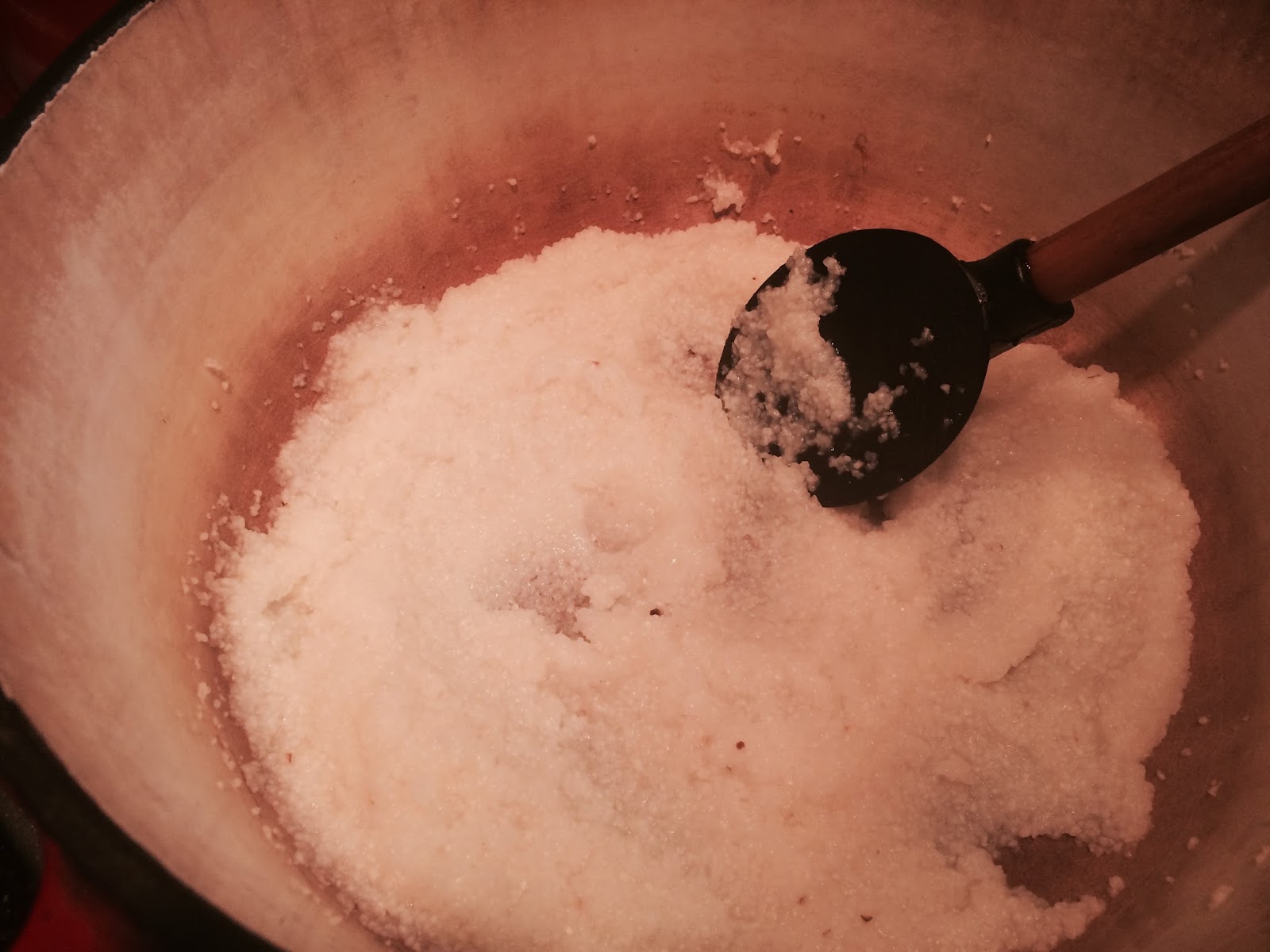
  2. Bring salt and 2 ¼ cups water to a boil in a large Dutch oven over high heat. Whisk in grits, and return to a boil. Cover, reduce heat to medium, and simmer 5 minutes or until thickened, whisking occasionally.
  3. Remove from heat; add cheese and sausage, stirring until cheese iscompletely melted.
  4. Stir in milk and next 4 ingredients.
  5. Spoon mixture into a lightly greased (with cooking spray) 10”x6” (or a 9”x9”) baking dish. (Casserole can be refrigerated at this point and baked later.)
  6. Bake in a preheated 350° for 50 minutes to 1 hour or until golden and cooked through. (If casserole was refrigerated, remove from fridge about 30 minutes before baking to allow it to come to room temperature.)
  7. Let stand 5 minutes before serving.

Recipe without photos . . .
Sausage-and-Grits Casserole   Makes 6 to 8 servingsPrint
¾ lb. bulk pork sausage
¼ teaspoon table salt
¾ cup uncooked quick-cooking grits
6 oz. sharp Cheddar cheese, shredded
½ cup milk
1 teaspoon fresh thyme leaves
¼ teaspoon garlic powder
¼ teaspoon black pepper
2 large eggs
Vegetable cooking spray
  1. Brown sausage in a large skillet over medium-high heat, stirring often, 7 to 9 minutes or until cooked and browned; drain on paper towels.
  2. Bring salt and 2 ¼ cups water to a boil in a large Dutch oven over high heat. Whisk in grits, and return to a boil. Cover, reduce heat to medium, and simmer 5 minutes or until thickened, whisking occasionally.
  3. Remove from heat; add cheese and sausage, stirring until cheese is completely melted.
  4. Stir in milk and next 4 ingredients.
  5. Spoon mixture into a lightly greased (with cooking spray) 10”x6” (or a 9”x9”) baking dish. (Casserole can be refrigerated at this point and baked later.)
  6. Bake in a preheated 350° for 50 minutes to 1 hour or until golden and cooked through. (If casserole was refrigerated, remove from fridge about 30 minutes before baking to allow it to come to room temperature.)
  7. Let stand 5 minutes before serving.

Turkey Hash

One of my favorite things about Thanksgiving is the leftover turkey bones. The bones go into a pot for soup and any leftover meat (not used in the soup) goes into the freezer. This dish uses one of those packets of frozen turkey meat and the hash was a nice accompaniment to our pressure cooked collard greens.

Turkey Hash
2 tablespoons+ olive oil
1 onion, chopped
2 garlic cloves, minced
1 russet potato, peeled & grated
About 1 cup of cooked turkey meat, chopped or shredded
About 1/4 cup roasted red peppers
Salt & pepper to taste

  1. Heat oil in skillet and then add onions and sauté. When almost tender, add garlic and cook until both onions and garlic are tender.
  2. Add grated potato, spread out in pan so it forms a thin layer. Cook on medium to medium high temperature until potato begins to brown on underside. 
  3. Flip and break apart; allow underside to brown.
  4. Add meat and cook until it begins to brown.
  5. Add roasted red pepper and allow to heat through. During this time, taste and season with salt and pepper as needed.
Recipe without photos . . .
Turkey Hash
2 tablespoons+ olive oil
1 onion, chopped
2 garlic cloves, minced
1 russet potato, peeled & grated
About 1 cup of cooked turkey meat, chopped or shredded
About 1/4 cup roasted red peppers
Salt & pepper to taste

  1. Heat oil in skillet and then add onions and sauté. When almost tender, add garlic and cook until both onions and garlic are tender.
  2. Add grated potato, spread out in pan so it forms a thin layer. Cook on medium to medium high temperature until potato begins to brown on underside. 
  3. Flip and break apart; allow underside to brown.
  4. Add meat and cook until it begins to brown.
  5. Add roasted red pepper and allow to heat through. During this time, taste and season with salt and pepper as needed.


Collard Greens in an electric pressure cooker

Pressure cooked collard greens with
turkey hash and corn bread.
Yes, we still have collard greens growing in our garden. They are definitely a sturdy veggie as evidenced by their ability to withstand some VERY cold weather, including an ice storm. Their sturdiness also means a long cooking time if you want tender greens.
Seemed to me that they would be an ideal veggie for my new electric pressure cooker . . . and I was right! Barry ate three helpings!

Collard Greens in an electric pressure cooker    4 servings
2 
tablespoons olive oil 
1 onion, chopped
3 garlic cloves, minced
1 bunch fresh collard greens
1 ½ cups chicken broth
2 tablespoons diced tomatoes
1 tablespoon balsamic vinegar
½ teaspoon salt 
1
teaspoon granulated sugar 
  1. Wash and clean collard greens; remove stem and tear/cut into bite-sized pieces.
  2. Toss the greens with the sugar and salt.
  3. Put chicken broth, oil, tomatoes, onion, garlic, and vinegar into the bottom of the pressure cooker and stir to combine the ingredients.
  4. Add collards; toss to coat with the broth-oil mixture.
  5. Pressure cook for 20 minutes following directions for specific cooker.
Recipe without photos . . .
Collard Greens in an electric pressure cooker    4 servings
2 
tablespoons olive oil 
1 onion, chopped
3 garlic cloves, minced
1 bunch fresh collard greens
1 ½ cups chicken broth
2 tablespoons diced tomatoes
1 tablespoon balsamic vinegar
½ teaspoon salt 
1
teaspoon granulated sugar 
  1. Wash and clean collard greens; remove stem and tear/cut into bite-sized pieces.
  2. Toss the greens and stems with the sugar and salt
  3. Put chicken broth, oil, tomatoes, onion, garlic, and vinegar into the bottom of the pressure cooker and stir to combine the ingredients.
  4. Add collards; toss to coat with the broth-oil mixture.
  5. Pressure cook for 20 minutes following directions for specific cooker.


Fruit Salad Christmas Tree -- fun, festive & nutritious!

  This is the fruit salad I put together for USD 435's Parents as Teachers holiday  
  meal . . . 


Fruit Salad Christmas Tree
Halos or clementines, peeled and divided into segments
Strawberries, hulled and cut in half
Apples, cored and sliced thin (dip in lemon juice to prevent browning)
Kiwi, peeled and cut into slices
Grapes, cut in half
A couple of cinnamon sticks
1 star anise
Fresh mint
Celery Seed Dressing

This is the way I assembled the fruit salad. (Vary amount and types of fruit to suit your own needs.)

  1. Create a base with the orange segments. I stacked them a couple of layers high.
  2. Add a second layer of strawberries; taper this layer to begin narrowing the tree, as shown above. Each subsequent layer should continue to taper to ultimately form a triangle shape.
  3. At this point, I just left a space for the apples as I wanted to add them at the last minutes. (I assembled the rest of the salad several hours in advance of the party.)
    I also went ahead and added some grape decorations to the fruit on the platter and cut some extra (which are located near the top of the platter) to add to the apple section).
  4. Add a layer of kiwi slices.
  5. Add grape decorations to the "tree."
  6. Add cinnamon sticks to the bottom of the tree to create a tree trunk.
  7. Add a star anise to the top for the "star."
  8. Tuck a few springs of mint into the "tree."
  9. Drizzle fruit lightly with Celery Seed Dressing.

Pressure Cooker Bread Pudding

Years ago I taught a unit on pressure cooking to students at Abilene High School. That was back in the days when pressure cookers were heavy duty pans that set on the burner of a stove and people were often afraid they’d blow up.
Before I taught that unit for the first time, I experimented with a pressure cooker at home. One of the first recipes I ever tried was one for bread pudding—the first time Barry or I had ever tasted this dessert . . . and we liked it.
Just recently I purchased a new fangled electric pressure cooker and decided to again give bread pudding a try. OH MY GOSH . . . it was delicious. Here’s the slightly update recipe adapted for an electric pressure cooker.
This makes a wonderful dessert but could also be eaten for breakfast.
Cubed & toasted bread.

Pressure Cooker Bread Pudding
4 tablespoons butter, melted
½ cup lightly packed brown sugar
3 cups whole milk (or use almond milk)
3 eggs, beaten
1 teaspoon vanilla extract
1 heaping teaspoon ground cinnamon
1/4 teaspoon salt
Dried fruit soaking in liquor.
7 ( ¾”) thick slices bread (I used homemade wheat berry bread), cubed and toasted (toast on a rimmed cookie sheet in 350º oven for 20 minutes stirring occasionally. Cool bread before continuing with recipe.)
½ cup dried fruit (I used a combination of raisins, craisins & dried cherries that I let soak in a blackberry liquor to plump; or use any other liquor of your choice or even just water)
¼ to ⅓ cup chopped walnuts or pecans
  1. In a large bowl, whisk together melted butter, brown sugar, milk, eggs, vanilla, cinnamon, and salt.
  2. Mix in cubed bread and raisins. Let rest 20 minutes until the bread absorbs the milk, stirring occasionally.
    Bread just added to milk mixture.
  3. Add chopped nuts and pour bread pudding into a buttered 1 ½-quart glass or metal baking dish. (Be sure it fits in your pressure cooking pot.) 
  4. Cover dish with foil. Prepare a foil sling for lifting the dish out of the pressure cooking pot by taking an 18” strip of foil and folding it lengthwise twice.
  5. Pour 1 ½ cups water into the pressure cooking pot and place the trivet in the bottom. Center the dish on the foil strip and lower it into the pressure cooker.
  6. Lock the lid in place. Select High Pressure and set the timer for 20 minutes. When beep sounds, turn off pressure cooker, and do a quick pressure release to release the pressure. When valve drops carefully remove lid.
  7. Remove dish from pressure cooking pot. If desired, put dish in preheated 350° oven for 5 to 10 minutes to crisp up the top.

    We added a dollop of Greek God's Honey Vanilla Yogurt to each serving of bread pudding. 
Recipe without photos . . .
Pressure Cooker Bread Pudding 
4 tablespoons butter, melted 
½ cup lightly packed brown sugar
3 cups whole milk (or use almond milk)
3 eggs, beaten
1 teaspoon vanilla extract
1 heaping teaspoon ground cinnamon
1/4 teaspoon salt
7 ( ¾”) thick slices bread (I used homemade wheat berry bread), cubed and toasted (toast on a rimmed cookie sheet in 350º oven for 20 minutes stirring occasionally. Cool bread before continuing with recipe.) 
½ cup dried fruit (I used a combination of raisins, craisins & dried cherries that I let soak in a blackberry liquor to plump; or use any other liquor of your choice or even just water)
¼ to ⅓ cup chopped walnuts or pecans
  1. In a large bowl, whisk together melted butter, brown sugar, milk, eggs, vanilla, cinnamon, and salt.
  2. Mix in cubed bread and raisins. Let rest 20 minutes until the bread absorbs the milk, stirring occasionally.
  3. Add chopped nuts and pour bread pudding into a buttered 1 ½-quart glass or metal baking dish. (Be sure it fits in your pressure cooking pot.)
  4.  Cover dish with foil. Prepare a foil sling for lifting the dish out of the pressure cooking pot by taking an 18” strip of foil and folding it lengthwise twice.
  5. Pour 1 ½ cups water into the pressure cooking pot and place the trivet in the bottom. Center the dish on the foil strip and lower it into the pressure cooker.
  6. Lock the lid in place. Select High Pressure and set the timer for 20 minutes. When beep sounds, turn off pressure cooker, and do a quick pressure release to release the pressure. When valve drops carefully remove lid.
  7. Remove dish from pressure cooking pot. If desired, put dish in preheated 350° oven for 5 to 10 minutes to crisp up the top.

Mabel's Corn & Bean EASY Dump Dip


At a recent MHS workshop, Mabel Carlson and her staff at Village Manor provided a  dip for the seasonal buffet table. Mabel describes it as an easy dump dip. Everyone else  described it as yummy, and Barry definitely gives it a thumbs up! Although it's not listed as an ingredient, we think fresh cilantro would make this even more delicious.


Mabel's Corn & Bean Dip
1 (15 oz.) can black beans, rinsed
1 (15 oz.) can whole corn, drained
1 bunch green onions (both green & white sections), chopped
24 oz. jar salsa
2 cups Cheddar cheese (we prefer sharp)

Combine ingredients. Chill and serve with whole grain tortilla scoopers.

Cinnamon Crisps (aka Elephant Ears)

Recently I made a batch of these Cinnamon Crisps for our niece to take back to college. My mom, who makes wonderful cinnamon rolls, wanted to learn how to make them so we made another batch a couple of days ago.

Cinnamon Crisps are also referred to as Elephant Ears. In the past I’ve used another recipe for Elephant Ears that I liked, but this one is also a winner!

Cinnamon Crisps  Makes 24 crisps
1 
(¼ oz.) pkg. (1 scant tablespoon) active dry yeast
1 ¼ 
cups milk
¼
 cup granulated sugar
¼ 
cup shortening
1 
teaspoon salt
1 
egg
½ cup packed brown sugar
½ cup (1 stick) butter, melted (divided)
½ teaspoon ground cinnamon
1 ½  teaspoon ground cinnamon
½ cup+ chopped pecans
           
1.  In a large mixing bowl combine 2 cups of the flour and the yeast.

2.  Heat milk, the ¼ cup granulated sugar, shortening, and salt just until warm (120 -130°) and shortening almost melts.
3.  Add milk mixture to flour mixture; add egg. Beat with an electric mixer on low speed for 30 seconds, scraping sides of bowl constantly. Beat 3 minutes on high speed.

4.  Stir in as much of the remaining flour as you can.
5.  Insert dough hook or turn dough out onto a lightly floured surface; knead in enough remaining flour to make a moderately soft dough that is smooth and elastic (3 to 5 minutes total).
6.  Shape into a ball. Place in a lightly greased bowl; turn once to grease surface. Cover; let rise in a warm place until double (1 to 1 ½ hours).
Dough before the rise (above).
Dough after the rise (below).

7.  Punch down; divide in half. Cover; let rest 10 minutes.

8.  Roll each dough half into a 12” square.

9.  Combine the ½ cup granulated sugar, the brown sugar, half (¼ cup) of the melted butter or margarine, and the ½ teaspoon ground cinnamon; spread half of the mixture over each square.

10. Roll each up into a spiral; seal seams. Cut into 12 slices.
11. Place cut sides down on greased baking sheets 3 to 4 inches apart. Flatten each slice to about 3” in diameter.


12. Cover; let rise until nearly double (about 30 minutes).
13. Cover with waxed paper. Using a rolling pin, roll to ⅛” thickness; remove paper.

14. Brush rolls with the remaining ¼ cup melted butter.

15. Combine the ¾ cup granulated sugar and the 1 ½ teaspoon cinnamon. Sprinkle cinnamon-sugar and chopped pecans over rolls.

16. Cover with waxed paper; roll flat again. Remove paper.
17. Bake in a preheated 400° oven 10 to 12 minutes or until golden brown. Immediately transfer from baking sheets to wire racks; cool.


Recipe without photos . . .
Cinnamon Crisps  Makes 24 crisps
3 ½ cups all-purpose flour
1 
(¼ oz.) pkg. (1 scant tablespoon) active dry yeast
1 ¼ 
cups milk
¼ 
cup granulated sugar
¼
 cup shortening
1 
teaspoon salt
1 
egg
½ cup packed brown sugar
½ cup (1 stick) butter, melted (divided)
½ teaspoon ground cinnamon
1 ½  teaspoon ground cinnamon
½ cup+ chopped pecans
            
1.  In a large mixing bowl combine 2 cups of the flour and the yeast. 
2.  Heat milk, the ¼ cup granulated sugar, shortening, and salt just until warm (120 -130°) and shortening almost melts. 
3.  Add milk mixture to flour mixture; add egg. Beat with an electric mixer on low speed for 30 seconds, scraping sides of bowl constantly. Beat 3 minutes on high speed. 
4.  Stir in as much of the remaining flour as you can.
5.  Insert dough hook or turn dough out onto a lightly floured surface; knead in enough remaining flour to make a moderately soft dough that is smooth and elastic (3 to 5 minutes total). 
6.  Shape into a ball. Place in a lightly greased bowl; turn once to grease surface. Cover; let rise in a warm place until double (1 to 1 ½ hours).
7.  Punch down; divide in half. Cover; let rest 10 minutes. 
8.  Roll each dough half into a 12” square. 
9.  Combine the ½ cup granulated sugar, the brown sugar, half (¼ cup) of the melted butter or margarine, and the ½ teaspoon ground cinnamon; spread half of the mixture over each square. 
10. Roll each up into a spiral; seal seams. Cut into 12 slices. 
11. Place cut sides down on greased baking sheets 3 to 4 inches apart. Flatten each slice to about 3” in diameter.
12. Cover; let rise until nearly double (about 30 minutes). 
13. Cover with waxed paper. Using a rolling pin, roll to ⅛” thickness; remove paper. 
14. Brush rolls with the remaining ¼ cup melted butter. 
15. Combine the ¾ cup granulated sugar and the 1 ½ teaspoon cinnamon. Sprinkle cinnamon-sugar and chopped pecans over rolls. 
16. Cover with waxed paper; roll flat again. Remove paper. 
17. Bake in a preheated 400° oven 10 to 12 minutes or until golden brown. Immediately transfer from baking sheets to wire racks; cool.