Showing posts with label Shortening. Show all posts

Famous Dave’s Cornbread Muffins (copycat recipe)

Moist and full of flavor, these corn muffins are the best I’ve made! Really good with a drizzle of two of honey. Super good with ham and beans, too. I wanted to serve them warm from the oven, so I assembled the three components ahead: 1) the dry ingredients, 2) creamed ingredient (that I stored in the fridge), 3) wet ingredients (that also went into the fridge. Then, about 30-35 minutes before serving, I preheated the oven, combined the ingredients and baked the muffins. There are several variations of Famous Dave’s recipe on the internet, this is the one I used. 


Famous Dave’s Cornbread Muffins (copycat recipe)   Yield: 14 to 16 muffins

Dry Ingredients:

1 3/4 cups cornmeal

1 1/2 cups all-purpose flour

2 teaspoons baking powder

3/4 teaspoon salt

1/4 teaspoon baking soda

-----

Creamed Ingredients:

3/4 cup granulated sugar

1/4 cup butter flavored Crisco® shortening

2 eggs

1/2 teaspoon vanilla

------

Wet Ingredients:

1 cup milk

1/3 cup vegetable oil

1/4 cup honey

------

Later Addition: 4 tablespoons butter

  1. Preheat oven to 400 degrees. Line a muffin pan with 14 to16 liners and set aside.

  2. Dry Ingredients: In a large bowl mix together cornmeal, flour, baking powder, salt, and baking soda.

  3. Creamed Ingredients: In a separate medium bowl, cream together sugar, shortening, eggs, and vanilla using an electric mixer.

  4. Pour the creamed ingredients into the bowl with the dry ingredients and stir.

  5. Wet Ingredients: Add in milk, vegetable oil, and honey. Mix well until batter is combined; it will still be a little lumpy but avoid overmixing. 

  6. Fill each muffin cup about 3/4 full and bake for 18 to 20 minutes; tops should be  golden and slightly browned. 

  7. Remove from oven and top each muffin with butter while they are hot so that the butter can melt and sink into the muffins.


Recipe without photos . . . Famous Dave’s Cornbread Muffins (copycat recipe)   Yield: 14 to 16 muffins

Dry Ingredients:

1 3/4 cups cornmeal

1 1/2 cups all-purpose flour

2 teaspoons baking powder

3/4 teaspoon salt

1/4 teaspoon baking soda

-----

Creamed Ingredients:

3/4 cup granulated sugar

1/4 cup butter flavored Crisco® shortening

2 eggs

1/2 teaspoon vanilla

------

Wet Ingredients:

1 cup milk

1/3 cup vegetable oil

1/4 cup honey

------

Later Addition: 4 tablespoons butter

  1. Preheat oven to 400 degrees. Line a muffin pan with 14 to16 liners and set aside.

  2. Dry Ingredients: In a large bowl mix together cornmeal, flour, baking powder, salt, and baking soda.

  3. Creamed Ingredients: In a separate medium bowl, cream together sugar, shortening, eggs, and vanilla using an electric mixer.

  4. Pour the creamed ingredients into the bowl with the dry ingredients and stir.

  5. Wet Ingredients: Add in milk, vegetable oil, and honey. Mix well until batter is combined; it will still be a little lumpy but avoid overmixing. 
  6. Fill each muffin cup about 3/4 full and bake for 18 to 20 minutes; tops should be  golden and slightly browned. 

  7. Remove from oven and top each muffin with butter while they are hot so that the butter can melt and sink into the muffins.


Pineapple Upside Down Cake

Kathy Coup's Peach Upside Down Cake receives yet another make over! Last fall I used her basic cake and brown sugar mixture but used slices of peeled apples instead of peaches. We used it for a cooking class and received rave reviews. The cake is tender and moist—the perfect base for the brown sugar glazed fruit.
Today I used canned pineapple, added walnuts to the cake batter and a little cinnamon to the brown sugar 

NOTE: This cake makes a great sweet treat for the current lock down we are now experiencing due to the COVID-19 crisis. As long as you have the basic staples and a can of fruit, you are set. And, yes, margarine can used in place of butter. Canned milk or even reconstituted dry milk can replace the whole milk I typically use.  And, a 9 or 10" cake pan could be used in place of a cast iron skillet. 

Check out the Make-Ahead tip listed at the end of the recipe. 

Pineapple Upside Down Cake    Make one 10" round cake
Dinette Cake
1 1/2 cups all-purpose flour
1 cup granulated sugar
2 teaspoons baking powder
1/4 teaspoon salt
1/3 cup shortening (Crisco)
About 1 teaspoon vanilla or other flavoring
2/3 cup milk
1 egg or 2 whites
1/2 to 3/4 cup coarsely chopped walnuts

Fruit Topping
1 stick butter
About 1 1/2 cups brown sugar 
1/2 teaspoon ground cinnamon
6 slices or rounds of canned pineapple, drained (pineapple chunks or even crushed pineapple could be used)
6 whole walnuts
  1. CAKE: Mix flour, sugar, baking powder, salt and shortening together in a bowl and mix until well blended. 
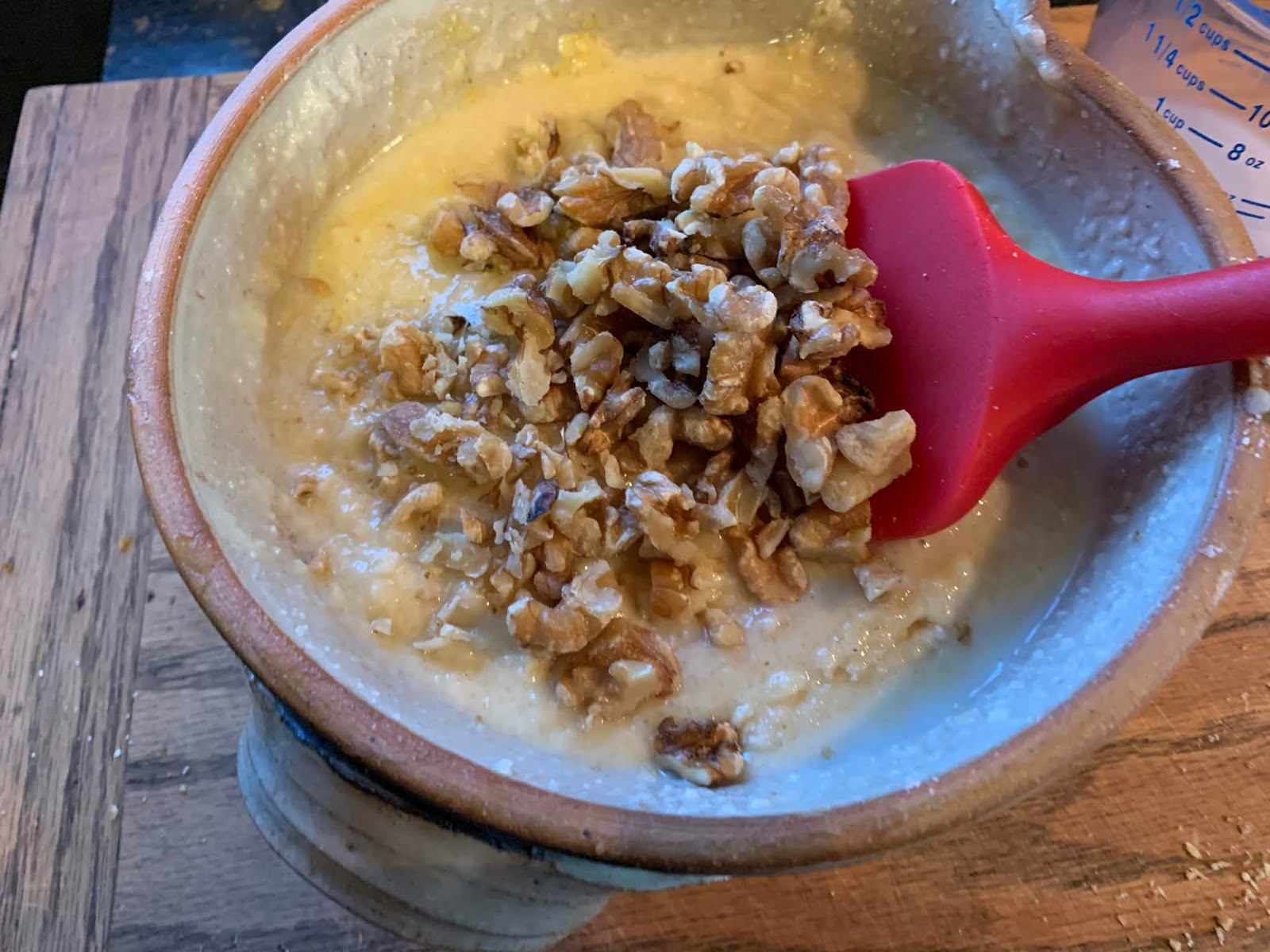
  2. Add vanilla, milk and egg (or whites) to dry ingredients. Mix and then fold in chopped walnuts, Set aside so it’s ready to spread over pineapple mixture. 
  3. TOPPING: Melt butter in a 10” cast iron skillet. 
  4. Mix brown sugar with cinnamon. Add enough brown sugar mixture, about 1 1/2 cups, to absorb butter.
  5. Arrange drained pineapple over the brown sugar mixture; place a walnut half in the center of each pineapple slice.
  6. Top with dollops of Dinette Cake batter; carefully spread batter to cover top of cake.
  7. Bake in a preheated 350° oven about 35 to 40 minutes or until golden brown on top and a  toothpick inserted in the middle of the cake comes out clean.
  8. Cool for a few minutes and then invert onto a serving plate.
MAKE AHEAD TIP: Follow step #1 above and then bag the "cake mix", label and date. It's ready to proceed to remaining steps whenever you need a quick dessert! 

Recipe without photos . . .
Pineapple Upside Down Cake    Make one 10" round cake
Dinette Cake
1 1/2 cups all-purpose flour
1 cup granulated sugar
2 teaspoons baking powder
1/4 teaspoon salt
1/3 cup shortening (Crisco)
About 1 teaspoon vanilla or other flavoring
2/3 cup milk
1 egg or 2 whites
1/2 to 3/4 cup coarsely chopped walnuts

Fruit Topping
1 stick butter
About 1 1/2 cups brown sugar 
1/2 teaspoon ground cinnamon
6 slices or rounds of canned pineapple, drained (pineapple chunks or even crushed pineapple could be used)
6 whole walnuts
  1. CAKE: Mix flour, sugar, baking powder, salt and shortening together in a bowl and mix until well blended. 
  2. Add vanilla, milk and egg (or whites) to dry ingredients. Mix and then fold in chopped walnuts, Set aside so it’s ready to spread over pineapple mixture. 
  3. TOPPING: Melt butter in a 10” cast iron skillet. 
  4. Mix brown sugar with cinnamon. Add enough brown sugar mixture, about 1 1/2 cups, to absorb butter.
  5. Arrange drained pineapple over the brown sugar mixture; place a walnut half in the center of each pineapple slice.
  6. Top with dollops of Dinette Cake batter; carefully spread batter to cover top of cake.
  7. Bake in a preheated 350° oven about 35 to 40 minutes or until golden brown on top and a  toothpick inserted in the middle of the cake comes out clean.
  8. Cool for a few minutes and then invert onto a serving plate.

Traditional Rolled Pie Crust

This is our go-to pie crust recipe . . .

Traditional Rolled Pie Crust
                                                For one 8 or 9” pie crust       
                                                                                                
All-purpose flour                    1 ½  cups                                
Salt                                          ½ teaspoon                            
Shortening (Crisco®)              ½ cup                                     
Cold water                               3 to 4 tablespoons                 


                                                For two 8 or 9” shells 
                                                or one 8 or 9” double crust
All-purpose flour                    2 ¼ cups
Salt                                          ¾ teaspoon
Shortening (Crisco®)              ¾ cup
Cold water                               5 to 6 tablespoons 

1.   Stir flour and salt together in mixing bowl. With a pastry blender, cut in shortening thoroughly. Particles should be size of tiny peas.
2.   Sprinkle water into the flour mixture, a tablespoon at a time. Mix lightly with a fork after each tablespoon of water until all flour is moistened.  
3.   Mix dough thoroughly just until it cleans the sides of the bowl. At this point just the right amount of gluten has developed to produce a tender, flaky crust.
4.   Gather the dough together with your hands and press firmly into a ball. If dough does not hold together, 1 or 2 additional teaspoons water may be added.
5.   To roll pastry,use a pastry cloth or wax paper which has been lightly sprinkled with flour.  Use a stockinet-covered rolling pin or place another piece of wax paper to cover the ball of dough.

6.   For two-crust pie, divide dough in half. Place half of dough cut side down. Flatten dough into circle to provide starting point for rolling out the pastry.
7.   Roll from center to outside edges in all four directions. For even thickness, lift rolling pin as you approach outer edge. If edges begin to break, pinch together at once.
8.   Keep pastry circular and roll it about 1 ½” larger all around than inverted pie pan. Fold pastry in half or wrap around rolling pin. Carefully transfer to pie pan.
9.   Unfold. To prevent stretching, ease pastry gently into pan and press toward center of pan with fingertips. Stretching causes shrinkage during baking. Flute or crimp edges as desired.
10. Add filling and bake as directed on pie recipe.

One-Crust Pies
Roll pasty about 2” beyond edge of inverted pan. Ease into pan. Trim to about 1” from edge. Make edge by folding pastry under.  Flute edges or decorate as desired. 
Pre-bake crusts for cream pies or other refrigerated pies such as fresh strawberry or peach. These crusts should be pricked (to prevent puffing) and are generally baked for about 8 to 10 minutes at 475°.
Add fillings that are to be baked (such as pumpkin or pecan) to an unbaked crust. Do not prick the crust when adding filling (the weight of the filling prevents air pockets and puffing). Follow recipe directions for baking temperature and length of baking.

Recipe without photos . . .
Traditional Rolled Pie Crust
                                                For one 8 or 9” pie crust       
                                                                                                
All-purpose flour                    1 ½  cups                                
Salt                                          ½ teaspoon                            
Shortening (Crisco®)              ½ cup                                     
Cold water                               3 to 4 tablespoons                 


                                                For two 8 or 9” shells 
                                                or one 8 or 9” double crust
All-purpose flour                    2 ¼ cups
Salt                                          ¾ teaspoon
Shortening (Crisco®)              ¾ cup
Cold water                               5 to 6 tablespoons 

1.   Stir flour and salt together in mixing bowl. With a pastry blender, cut in shortening thoroughly. Particles should be size of tiny peas.
2.   Sprinkle water into the flour mixture, a tablespoon at a time. Mix lightly with a fork after each tablespoon of water until all flour is moistened.  
3.   Mix dough thoroughly just until it cleans the sides of the bowl. At this point just the right amount of gluten has developed to produce a tender, flaky crust.
4.   Gather the dough together with your hands and press firmly into a ball. If dough does not hold together, 1 or 2 additional teaspoons water may be added.
5.   To roll pastry,use a pastry cloth or wax paper which has been lightly sprinkled with flour.  Use a stockinet-covered rolling pin or place another piece of wax paper to cover the ball of dough.
6.   For two-crust pie, divide dough in half. Place half of dough cut side down. Flatten dough into circle to provide starting point for rolling out the pastry.
7.   Roll from center to outside edges in all four directions. For even thickness, lift rolling pin as you approach outer edge. If edges begin to break, pinch together at once.
8.   Keep pastry circular and roll it about 1 ½” larger all around than inverted pie pan. Fold pastry in half or wrap around rolling pin. Carefully transfer to pie pan.
9.   Unfold. To prevent stretching, ease pastry gently into pan and press toward center of pan with fingertips. Stretching causes shrinkage during baking. Flute or crimp edges as desired.
10. Add filling and bake as directed on pie recipe.

One-Crust Pies
Roll pasty about 2” beyond edge of inverted pan. Ease into pan. Trim to about 1” from edge. Make edge by folding pastry under.  Flute edges or decorate as desired. 
Pre-bake crusts for cream pies or other refrigerated pies such as fresh strawberry or peach. These crusts should be pricked (to prevent puffing) and are generally baked for about 8 to 10 minutes at 475°.
Add fillings that are to be baked (such as pumpkin or pecan) to an unbaked crust.  Do not prick the crust when adding filling (the weight of the filling prevents air pockets and puffing).  Follow recipe directions for baking temperature and length of baking.

Easter Peppernut Buns

Although these is not what I typically think of when thinking of peppernuts, recipes like this one were brought by German Mennonites who immigrated from Russia  to the U.S. in the 1870s. Having read several of Norma Jost Voth's books on Russian Mennonites cookery, I was also aware that peppernuts were not just confined to Christmas. Mrs. Voth relates stories of eating peppernuts and drinking fresh squeezed lemonade during the summer. And, then I discovered that with a little frosting and some sprinkles, you could turn the yeast peppernuts into Easter buns.
I used a recipe from Mrs. Voth (“Peppernuts, Plain and Fancy," 1978, pp. 67 & 69) and just added sprinkles.

Easter Peppernut Buns    Makes about 60 buns
2 tablespoon dry active yeast
½ cup warm water (about 110-115° F.)
2 tablespoons granulated sugar
2/3 cup shortening (Crisco)
¾ cup granulated sugar
½ cup molasses
2 large eggs
2 cups warm milk (about 110-115° F.)
1 teaspoon salt
1 tablespoon ground cinnamon
1 teaspoon ground cardamom
¾ teaspoon white pepper
7 to 8 cups unbleached or bread flour

1.  In a small bowl, dissolve yeast in warm water and 2 tablespoons sugar; let proof until bubbly.

2.  Cream shortening ¾ cup sugar and molasses.

3.  Beat in eggs.

4.  Add warm milk, spices, proofed yeast and half the flour; beat 5 minutes with electric mixer.

5.  Gradually add enough of the remaining flour to create a smooth dough that leaves side of bowl.

6.  Turn out onto floured board (or add dough hook to electric mixer) and knead until smooth and elastic (5 to 10 minutes), adding more flour if dough becomes sticky. (Avoid too much flour so you will not have dry dough!)

7.  Place in a greased bowl and turn dough to cover all surfaces.

8.  Cover with a kitchen towel (or plastic wrap) and let rise until doubled in bulk (about an hour). Note: To test for double in size . . . press the tips of two fingers lightly and quickly ½” into the dough; if the dent stays, it is double.

9.  Punch dough down and let rise again. (The long rising time yields a fluffy bun.)

10. Turn onto floured board and knead lightly.
11. Pinch or cut off 2” pieces of dough (1 ½ oz. each), making balls between palms of hands.

12. Place close together on greased (or sprayed) baking sheet(s) so they rise high; spray tops of rolls lightly with pan spray.

13. Cover and let rise until almost doubled in size (up to an hour).

14. Bake in a preheated 350° F. oven for 25 to 30 minutes or until golden brown. Another indication of doneness: remove a roll and tap the bottom — it should have a hollow sound.

15. Cool slightly on rack and then frost with  powdered sugar icing and decorate with sprinkles.

Powdered Sugar Icing: Combine 2 cups sifted powdered sugar, 1 teaspoon milk, 1 tablespoon softened butter, ½  teaspoon vanilla or other flavoring of choice. Adjust amounts until desired consistency is achieved,     
The buns are ready and the table is set.

Recipe without photos . . .
Easter Peppernut Buns    Makes about 60 buns
2 tablespoon dry active yeast
½ cup warm water (about 110-115° F.)
2 tablespoons granulated sugar
2/3 cup shortening (Crisco)
¾ cup granulated sugar
½ cup molasses
2 large eggs
2 cups warm milk (about 110-115° F.)
1 teaspoon salt
1 tablespoon ground cinnamon
1 teaspoon ground cardamom
¾ teaspoon white pepper
7 to 8 cups unbleached or bread flour

1.  In a small bowl, dissolve yeast in warm water and 2 tablespoons sugar; let proof until bubbly.
2.  Cream shortening ¾ cup sugar and molasses.
3.  Beat in eggs.
4.  Add warm milk, spices, proofed yeast and half the flour; beat 5 minutes with electric mixer.
5.  Gradually add enough of the remaining flour to create a smooth dough that leaves side of bowl. 
6.  Turn out onto floured board (or add dough hook to electric mixer) and knead until smooth and elastic (5 to 10 minutes), adding more flour if dough becomes sticky. (Avoid too much flour so you will not have dry dough!)
7.  Place in a greased bowl and turn dough to cover all surfaces.
8.  Cover with a kitchen towel (or plastic wrap) and let rise until doubled in bulk (about an hour). Note: To test for double in size . . . press the tips of two fingers lightly and quickly ½” into the dough; if the dent stays, it is double.
9.  Punch dough down and let rise again. (The long rising time yields a fluffy bun.)
10. Turn onto floured board and knead lightly. 
11. Pinch or cut off 2” pieces of dough (1 ½ oz. each), making balls between palms of hands. 
12. Place close together on greased (or sprayed) baking sheet(s) so they rise high; spray tops of rolls lightly with pan spray.
13. Cover and let rise until almost doubled in size (up to an hour).
14. Bake in a preheated 350° F. oven for 25 to 30 minutes or until golden brown. Another indication of doneness: remove a roll and tap the bottom — it should have a hollow sound.
15. Cool slightly on rack and then frost with  powdered sugar icing and decorate with sprinkles.

Powdered Sugar Icing: Combine 2 cups sifted powdered sugar, 1 teaspoon milk, 1 tablespoon softened butter, ½  teaspoon vanilla or other flavoring of choice. Adjust amounts until desired consistency is achieved,   

Angel Flake Biscuits — a cross between a biscuit & a roll

Barry’s sister,  Lorraine,  gave me this recipe years ago. Angel biscuits are a cross between a biscuit and a roll in that they contain both baking powder, soda and yeast; you roll them out like a biscuit but they rise like a roll. The really nice thing is that you can mix up the dough, stash it in the fridge and make biscuits whenever you are ready.

Angel Flake Biscuits   Makes about 1½ dozen (2 1/4") biscuits
1 tablespoon active dry yeast 
½ cup lukewarm water (105-115°)
5 cups all-purpose flour (or use part whole wheat)
1 tablespoon baking powder
1 teaspoon baking soda
3 tablespoons granulated sugar
1 teaspoon salt
¾ cup vegetable shortening (butter-flavored Crisco®)
2 cups buttermilk
Melted butter for brushing on baking sheet & over biscuits before baking
  1. Dissolve yeast in water, allowing it to activate and bubble.
  2. Thoroughly mix flour, baking powder, baking soda, sugar and salt in a mixing bowl.
  3. Cut shortening into flour mixture (using a pastry blender or flat blade of Kitchen Aid mixer)
  4. Add yeast mixture. Then add 2 cups buttermilk. Mix until all the flour mixture in moistened.
  5. Cover bowl (or transfer to another) and store in the refrigerator. The dough will keep for a couple of weeks in the refrigerator.
  6. When ready to use, take out desired amount. On a floured board, roll out to ½” thickness. Cut out biscuits using a biscuit cutter.
  7. Place on a baking sheet that has been lightly brushed with melted butter. Cover and let rise for 1 hour or until doubled in bulk.
  8. Brush biscuits with melted butter.
  9. Bake in a preheated 425° oven for 8 to 10 minutes or until nicely browned.
Recipe without photos . . .
Angel Flake Biscuits   Makes about 1½ dozen (2 1/4") biscuits
1 tablespoon active dry yeast 
½ cup lukewarm water (105-115°)
5 cups all-purpose flour (or use part whole wheat)
1 tablespoon baking powder
1 teaspoon baking soda
3 tablespoons granulated sugar
1 teaspoon salt
¾ cup vegetable shortening (butter-flavored Crisco®)
2 cups buttermilk
Melted butter for brushing on baking sheet & over biscuits before baking
  1. Dissolve yeast in water, allowing it to activate and bubble.
  2. Thoroughly mix flour, baking powder, baking soda, sugar and salt in a mixing bowl.
  3. Cut shortening into flour mixture (using a pastry blender or flat blade of Kitchen Aid mixer)
  4. Add yeast mixture. Then add 2 cups buttermilk. Mix until all the flour mixture in moistened.
  5. Cover bowl (or transfer to another) and store in the refrigerator. The dough will keep for a couple of weeks in the refrigerator.
  6. When ready to use, take out desired amount. On a floured board, roll out to ½” thickness. Cut out biscuits using a biscuit cutter.
  7. Place on lightly greased or sprayed baking sheet. Cover and let rise for 1 hour or until doubled in bulk.
  8. Brush biscuits with melted butter.
  9. Bake in a preheated 425° oven for 8 to 10 minutes or until nicely browned